
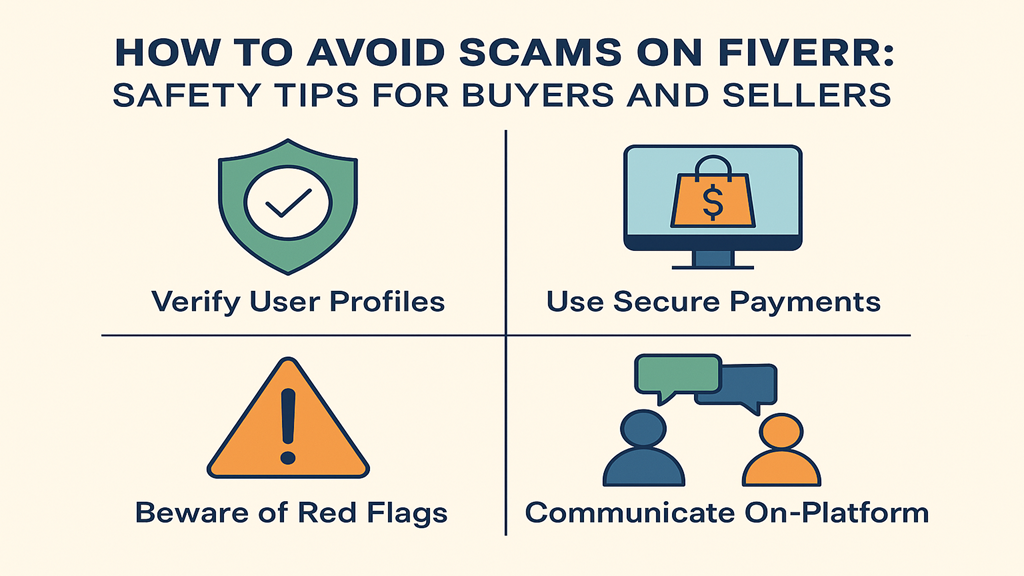
How to avoid scams on Fiverr is one of the most important questions buyers and sellers must ask before using the platform. As the global freelancing economy continues to grow, Fiverr has become a leading marketplace for digital services—but its popularity also makes it a target for fraudulent activity.
Table of Contents
🔹Introduction: Why Fiverr Scams Exist and Why You Must Be Careful
The global freelancing economy has experienced explosive growth over the past decade, and Fiverr has emerged as one of the most popular marketplaces connecting buyers and sellers worldwide. With millions of users, thousands of new gigs published daily, and transactions happening every minute, Fiverr offers immense opportunity—but it also attracts scammers who seek to exploit trust, inexperience, and urgency.
Understanding how to avoid scams on Fiverr is no longer optional. Whether you are a buyer outsourcing work or a seller offering services, knowing how scams operate and how to protect yourself can save you money, time, reputation, and even your account.
Unlike traditional employment platforms, Fiverr operates on a fast-paced gig economy model. This speed and accessibility are part of its strength, but they also create gaps that bad actors attempt to exploit. Scammers continuously evolve their methods, adapting to Fiverr’s policies and preying on users who are unaware of common red flags.
Many users mistakenly assume that Fiverr scams only target beginners. In reality, even experienced freelancers and long-term buyers can fall victim if they become complacent or rush decisions. Scams can appear professional, well-written, and convincing—often mimicking legitimate Fiverr interactions.
This guide is designed to provide a complete, practical, and up-to-date safety framework for navigating Fiverr securely. It addresses both sides of the marketplace, because buyer scams and seller scams differ significantly in structure and intent.
By the end of this guide, you will understand:
- Whether Fiverr is genuinely safe to use
- The most common Fiverr scams affecting buyers and sellers
- Warning signs that indicate fraudulent behavior
- Step-by-step safety practices for both roles
- What to do if you are already affected by a scam
- Which tools can enhance your online safety while freelancing
This article is written from a professional, trust-based perspective and follows ethical SEO practices, ensuring clarity, accuracy, and compliance with advertising and content standards.
In this guide, we begin by explaining the common Fiverr scams targeting buyers and how to identify them before placing an order
common Fiverr scams targeting buyers:
https://topratedaffi.com/recommends/kespersky
🔹Is Fiverr Legit or a Scam? Understanding the Platform’s Safety Model
A common question among new users is whether Fiverr itself is a scam. The short and accurate answer is no—Fiverr is a legitimate platform, publicly established, globally recognized, and used by businesses ranging from startups to Fortune 500 companies.
However, legitimacy does not equal immunity from fraud.
How Fiverr Works at a Structural Level
Fiverr operates as a marketplace intermediary. It does not directly employ freelancers or buyers but facilitates transactions through:
- An escrow-based payment system
- On-platform messaging
- Order tracking and delivery confirmation
- A dispute resolution mechanism
When a buyer places an order, funds are held by Fiverr and released to the seller only after the order is marked complete. This structure significantly reduces direct payment fraud when used correctly.
Fiverr’s Built-In Protection Systems
Fiverr provides several safety mechanisms:
- Mandatory on-platform payments
- Automated fraud detection systems
- Account verification processes
- Trust and Safety enforcement teams
- Reporting and dispute resolution tools
Despite these protections, scammers still find ways to manipulate users into bypassing safeguards—most commonly by pushing communication or payments outside Fiverr’s system.
Why Scams Still Occur on Fiverr
Scams occur not because Fiverr is unsafe by design, but because:
- Users bypass platform rules
- Scammers exploit human psychology (urgency, fear, greed)
- New users are unfamiliar with Fiverr policies
- Fake credibility is easy to manufacture online
Understanding this distinction is crucial. Fiverr provides the tools for safety, but users must actively use them.
Fiverr enforces strict platform rules through its Fiverr Trust and Safety policies, which prohibit off-platform payments, impersonation, and fraudulent activity.
https://www.fiverr.com/trust-safety
🔹 How Fiverr Protects Buyers and Sellers
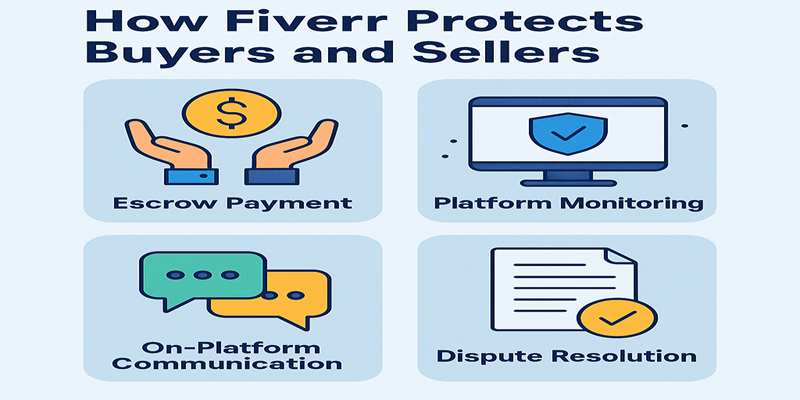
Fiverr is designed with multiple built-in safeguards to protect both buyers and sellers throughout the transaction lifecycle. While no online marketplace can guarantee zero fraud, Fiverr significantly reduces risk by enforcing platform rules, secure payment handling, and monitored communication.
One of the most important protections Fiverr offers is its strict enforcement of on-platform activity. Fiverr clearly prohibits off-platform payments, impersonation, and deceptive practices through its official Fiverr Trust and Safety policies. Any attempt to bypass these rules can result in account suspension or permanent removal.
Fiverr Trust and Safety policies
https://www.fiverr.com/trust-safety
From a financial standpoint, Fiverr uses Fiverr’s escrow-based payment system to protect both parties. When a buyer places an order, the payment is held securely by Fiverr and is only released to the seller after the buyer confirms that the work has been delivered as agreed. This structure minimizes direct payment fraud and ensures accountability.
Fiverr also protects users through:
- Mandatory on-platform messaging, which allows Fiverr to review conversations during disputes
- Order tracking and delivery confirmation systems
- A Resolution Center for handling disagreements professionally
- Automated systems that detect suspicious behavior patterns
These protections work best when users follow Fiverr’s rules closely. Scams most often occur when users are persuaded to step outside the platform’s safeguards.
Fiverr’s escrow-based payment system
https://www.fiverr.com/support/articles/360010451418
🔹Common Fiverr Scams Targeting Buyers
Buyers are frequently targeted because they control the funds. Scammers attempt to obtain payment without delivering legitimate work or by delivering unusable content.
Fake Portfolio and Stolen Samples Scam
One of the most widespread buyer scams involves sellers presenting stolen portfolios. These sellers often:
- Copy work from top Fiverr sellers
- Use images from Dribbble, Behance, or Google
- Claim experience they do not have
Once hired, the seller delivers low-quality or entirely different work, hoping the buyer will miss the delivery window or accept it out of frustration.
How to avoid it:
- Reverse-image search portfolio samples
- Ask specific questions about the work process
- Review long-term feedback patterns, not just ratings
🔹 Account Security for Fiverr Users
Account security is a critical but often overlooked aspect of avoiding scams on Fiverr. While Fiverr actively monitors suspicious activity, individual users are still responsible for protecting their login credentials and digital access.
Many scams begin with attempts to compromise accounts rather than direct financial fraud. Once an account is taken over, scammers can impersonate legitimate users, manipulate orders, or exploit stored payment information.
To reduce risk, Fiverr users should follow basic security best practices:
- Use a strong, unique password that is not reused on other websites
- Enable two-factor authentication (2FA) in account settings
- Log out from shared or public devices
- Avoid browser extensions or third-party tools that request Fiverr access
Understanding how online scams and malware work helps users recognize malicious behavior before damage occurs. Scam links are often disguised as project files, verification requests, or urgent system alerts.
how online scams and malware work
https://www.kaspersky.com/resource-center/threats/scams
Phishing remains one of the most common threats. Attackers use fake login pages and deceptive messages to steal credentials using common phishing attack techniques. These messages often create urgency, such as warnings about account suspension or payment issues.
common phishing attack techniques
https://www.cloudflare.com/learning/access-management/phishing-attack/
Maintaining strong account security is not only about personal safety—it also protects your professional reputation on the platform.
🔹 External Links, Files, and Download Safety
External links and file downloads are a frequent entry point for Fiverr-related scams. Both buyers and sellers should exercise caution when receiving links or attachments, even when they appear to come from legitimate users.
Scammers often send links claiming to be:
- Google Drive or Dropbox files
- Project briefs or design assets
- Invoices or order confirmations
- Fiverr verification or security notices
These links may lead to fake login pages or malware downloads designed to steal credentials or infect devices. Users should never click unknown links or download files unless they are absolutely necessary and expected.
Modern browsers rely on Google Safe Browsing technology to warn users about malicious websites, but these systems are not foolproof. It is still essential to manually verify links, check URLs carefully, and avoid entering Fiverr login details on external websites.
Best practices for file and link safety include:
- Requesting file delivery through Fiverr’s built-in system whenever possible
- Scanning downloaded files with updated security software
- Avoiding compressed or executable files from unknown sources
- Treating “urgent” external links with skepticism
By practicing cautious link and file handling, users can significantly reduce the risk of phishing attacks, malware infections, and account compromise.
Fiverr Trust and Safety policies
https://www.fiverr.com/trust-safety
🔹Off-Platform Payment Requests
Any request to pay outside Fiverr is a major red flag. Scammers may suggest:
- PayPal or crypto discounts
- “Faster delivery” outside the platform
- Direct bank transfers
Once payment leaves Fiverr, you lose all protection.
Rule:
Never pay outside Fiverr—under any circumstances.
🔹Low-Quality AI or Recycled Content Scam
With the rise of AI tools, some sellers deliver:
- Automatically generated articles
- Reused templates sold repeatedly
- Content that violates copyright rules
These sellers rely on volume and speed rather than quality.
How to avoid it:
- Request originality assurances
- Use plagiarism detection tools
- Review seller gig descriptions carefully
🔹Impersonation of Fiverr Support
Some scammers pose as Fiverr staff through messages, asking buyers to:
- “Verify” payment details
- Click suspicious links
- Download external files
Fiverr will never contact you through normal user inbox messages asking for sensitive information.
🔹Common Fiverr Scams Targeting Sellers
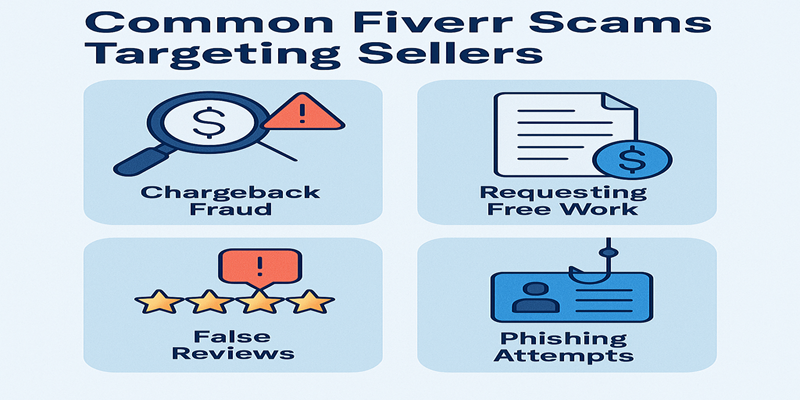
Sellers face different risks, primarily involving free labor extraction and account manipulation.
Fake Buyers Requesting Free Samples
These buyers often:
- Claim they need a “quick sample”
- Promise future large orders
- Ask for unpaid work via messages
Once they receive the work, they disappear.
Protection tip:
Never provide unpaid samples beyond what is stated in your gig.
🔹Chargeback and Cancellation Abuse
Some buyers exploit Fiverr’s dispute system by:
- Requesting revisions endlessly
- Claiming dissatisfaction after receiving full work
- Filing disputes to force refunds
This can be minimized through:
- Clear gig descriptions
- Documented communication
- Watermarked or staged delivery
🔹Phishing and Account Takeover Attempts
Scammers may send links disguised as:
- Fiverr documents
- “Verification” requests
- External project files
Clicking these links can compromise your account.
Scammers often rely on common phishing attack techniques to trick users into clicking fake Fiverr login links or downloading malicious files.
https://www.cloudflare.com/learning/access-management/phishing-attack
🔹Red Flags That Instantly Signal a Fiverr Scam
Recognizing red flags early prevents losses.
Behavioral Warning Signs
- Urgency pressure (“respond in 10 minutes”)
- Poor grammar combined with high-value claims
- Refusal to use Fiverr order system
- Overly generous offers with little explanation
Profile-Based Warning Signs
- New account with expensive offers
- Inconsistent reviews
- Stolen profile images
- Generic gig descriptions
Many online fraud patterns follow behaviors outlined in the Federal Trade Commission scam prevention guidelines, which help users identify pressure tactics and impersonation scams.
Federal Trade Commission scam prevention guidelines
https://consumer.ftc.gov/scams
🔹Fiverr Safety Tips for Buyers: Step-by-Step Protection Guide
Buyers on Fiverr often assume that paying through a trusted platform automatically guarantees a safe outcome. While Fiverr’s escrow system provides a strong foundation, buyer safety ultimately depends on informed decision-making. The following best practices significantly reduce your risk of being scammed.
1. Choose Sellers Strategically, Not Emotionally
Avoid making decisions based solely on price or speed. Scammers frequently use extremely low pricing or unrealistic delivery times to trigger impulsive purchases.
What to evaluate instead:
- Seller longevity on Fiverr
- Consistency in recent reviews
- Level of detail in gig descriptions
- Professional communication style
A trustworthy seller usually explains their process clearly and does not rush you into placing an order.
2. Learn How to Read Fiverr Reviews Properly
Not all five-star reviews are equal. Some scams rely on:
- Short, generic reviews (“Great work,” “Amazing seller”)
- Large clusters of reviews within a short timeframe
- Reviews that do not match the service offered
Safer approach:
- Read 3–4 negative or neutral reviews first
- Look for problem-solving behavior in seller responses
- Focus on reviews describing similar projects to yours
3. Keep All Communication on Fiverr
Fiverr’s monitoring and dispute tools only work if communication stays on-platform. Scammers often attempt to move conversations to:
- Telegram
- Google Drive chats
This is usually framed as “convenience” or “faster communication.”
Golden rule:
If it’s not on Fiverr, it doesn’t exist legally.
4. Use the Fiverr Order System Correctly
Always:
- Place an order before work begins
- Use milestones for large projects
- Request revisions through official channels
- Avoid accepting deliveries until work is reviewed
Never click “Accept” unless the order is fully completed to your satisfaction.
5. Understand Fiverr’s Dispute and Resolution Process
If something goes wrong:
- Contact the seller calmly
- Request clarification or revision
- Use the Resolution Center if needed
- Escalate only with documented evidence
Avoid emotional language; factual communication is more effective.
🔹Fiverr Safety Tips for Sellers: Protecting Your Income and Account
Sellers face risks that go beyond payment loss. Scams can damage ratings, trigger account warnings, or even lead to permanent suspension.
1. Define Clear Gig Boundaries
Many seller scams succeed because boundaries are vague. Your gig description should clearly state:
- What is included
- What requires extra payment
- Number of revisions
- Delivery format
Ambiguity benefits scammers—not sellers.
2. Never Provide Free Work Outside Your Gig Scope
Requests for “samples,” “tests,” or “trial work” without payment are common scam tactics.
Safer alternatives:
- Show portfolio samples only
- Offer a paid test gig
- Provide previews or outlines
Professional buyers respect professional boundaries.
3. Protect Your Work Before Delivery
For design, writing, or development work:
- Use watermarks
- Deliver partial files first
- Lock editable formats until approval
This discourages buyers from stealing work and canceling orders.
4. Watch for Manipulative Buyer Behavior
Red flags include:
- Endless revision requests beyond scope
- Threats of bad reviews
- Requests to break Fiverr rules
- Sudden dissatisfaction after full delivery
If manipulation occurs, document everything and contact Fiverr support early.
5. Secure Your Fiverr Account
Account compromise is a growing issue. Sellers should:
- Use strong, unique passwords
- Enable two-factor authentication
- Avoid clicking unknown links
- Log out from shared devices
Account security is part of professional freelancing.
🔹What to Do If You’re Scammed on Fiverr
Even with precautions, scams can still happen. Acting quickly and correctly improves your chances of recovery.
Step 1: Stop Further Interaction
Do not continue negotiating outside Fiverr or agree to new terms.
Step 2: Collect Evidence
Save:
- Chat screenshots
- Delivery files
- Order details
- Policy violations
Clear documentation strengthens your case.
Step 3: Use Fiverr’s Resolution Center
File a dispute explaining:
- What was promised
- What was delivered
- How it violates Fiverr terms
Remain factual and concise.
Step 4: Escalate to Fiverr Support
If unresolved, escalate to Fiverr’s Trust & Safety team. Fiverr reviews:
- Communication history
- Order behavior
- Policy compliance
Avoid chargebacks unless Fiverr advises it, as they may lead to account penalties.
🔹Fiverr vs Other Freelance Platforms: Safety Comparison
Understanding how Fiverr compares to alternatives helps contextualize its safety level.
Fiverr vs Upwork
- Fiverr: Fixed-price, fast transactions
- Upwork: Contract-based, time tracking
- Fiverr scams rely more on volume
- Upwork scams rely more on fake job postings
Fiverr vs Freelancer.com
- Fiverr has stronger escrow enforcement
- Freelancer has higher spam volume
- Fiverr’s dispute process is faster
Fiverr vs PeoplePerHour
- Smaller user base
- Less scam volume
- Fewer automated protections
Overall, Fiverr remains one of the safer marketplaces when used correctly.
Platforms such as Upwork also enforce strict rules through their Upwork Trust and Safety policies, offering a useful comparison for marketplace security standards.
https://support.upwork.com/hc/en-us/articles/211062178
🔹Best Tools to Protect Yourself on Fiverr (Recommended)
Using external tools enhances your security beyond Fiverr’s built-in systems.
(Only 4 affiliate recommendations are used in this article.)
1. NordVPN (Best Overall Protection)
A VPN protects your:
- IP address
- Location data
- Public Wi-Fi sessions
This is especially important for freelancers working remotely or traveling.
2. Password Manager (LastPass or 1Password)
Prevents:
- Credential reuse attacks
- Account takeovers
- Phishing-based access
3. Malware and Phishing Protection Software
Helps block:
- Fake Fiverr login pages
- Malicious download links
- Browser-based threats
4. Secure Cloud Backup Tool
Protects your work files against:
- Data loss
- Account disputes
- Device failure
🔹Frequently Asked Questions (FAQ)
Is Fiverr safe for beginners?
Yes, but beginners are more vulnerable due to unfamiliarity with platform rules.
Can Fiverr refund scam orders?
In many cases, yes—if platform rules were followed.
Does Fiverr protect sellers?
Yes, especially when communication and delivery occur on-platform.
Are Fiverr messages monitored?
Yes, for policy violations and scam patterns.
🔹Final Thoughts: Fiverr Can Be Safe If You Use It Wisely
Fiverr is neither inherently dangerous nor automatically safe. Like any large online marketplace, it reflects the behavior of its users. The key to success lies in awareness, discipline, and professional conduct.
By following the strategies outlined in this guide, buyers can invest confidently, and sellers can build sustainable, scam-resistant careers.
🔹Author Bio
Mamdhuha AL Lashirah is a digital marketplace analyst and online safety writer specializing in freelancing platforms, scam prevention, and trust-based online transactions. With extensive experience researching Fiverr, Upwork, and global gig economies, Mamdhuha helps buyers and freelancers protect their income, reputation, and digital presence through informed decision-making.